How to Spot a Fake Bank Statement
Andreas Bergman, Founder of VeriRentPublished July 24, 2026 · Updated August 10, 2026
Disclosure: I founded VeriRent, which sells the screening service mentioned in this guide. The checks and limitations here are published so you can use them without buying it.
Key takeaways
- Start with the balance math. Opening balance plus credits minus debits must equal closing balance.
- Check the statement period, transaction order, and recurring deposits before judging how the document looks.
- Broken number alignment, inconsistent fonts, and editing-tool metadata are reasons to investigate. None proves fraud by itself.
- Automated forensics can show you what deserves review. It cannot prove the balance is real or make the decision for you.
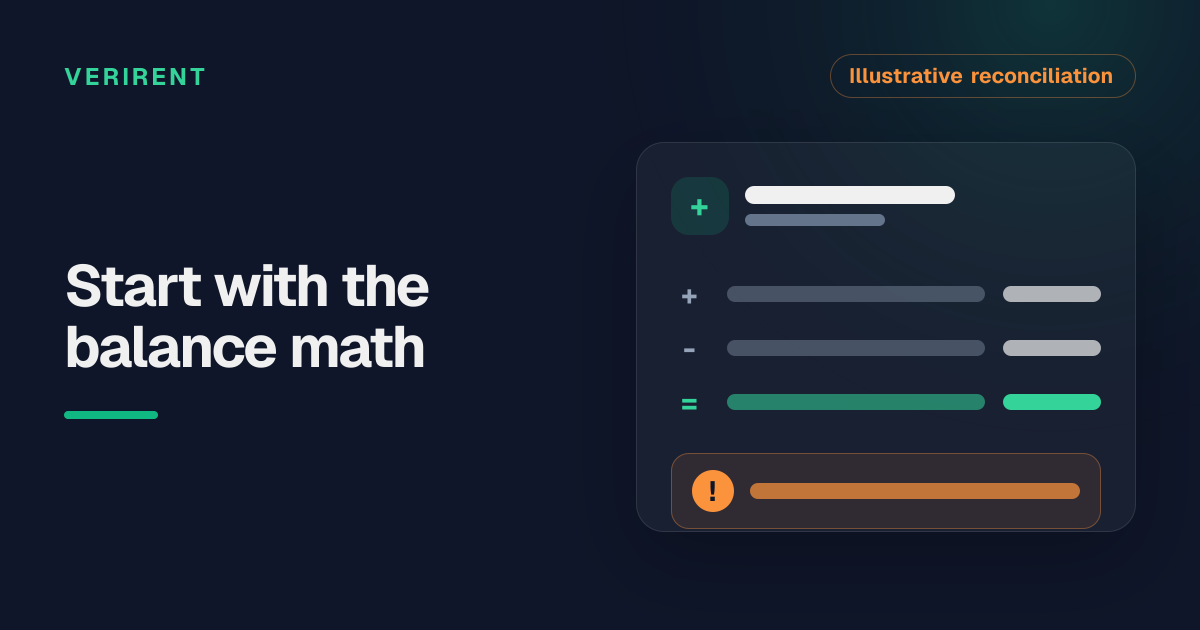
The statement says the applicant finished the month with $8,942.16. It opened at $2,184.71, with $5,200.00 in deposits and $2,442.55 in withdrawals. That comes to $4,942.16, not $8,942.16. If you want to spot a fake bank statement, start there. Ignore the logo and run the numbers.
A pay stub gives you a short list of fields to check. Gross pay, deductions, net pay, year to date. A bank statement can give you pages of deposits, card purchases, transfers, fees, reversals, and running balances. One changed figure can force several other figures to change with it. That makes the document harder to edit cleanly, but also harder for a busy landlord to review.
Why bank statements deserve a forensic check
If pay stubs are the first income document you scrutinize, bank statements should be second. They're often used to corroborate payroll deposits, self-employment income, savings, or cash available for move-in. They also lack the relatively narrow layouts used by payroll systems. Every bank has its own format, and those formats change.
Fraudulent income documents are not an edge case for large operators. In the National Multifamily Housing Council's 2024 survey, 93.3% of 75 large rental operators said they had experienced application fraud in the previous 12 months. Among the operators that experienced fraud, 84.3% had seen falsified pay stubs, employment references, or other income documentation. These were large operators, so the percentage should not be projected onto every landlord. The useful point is narrower: an income document needs verification, not a glance.
A professional-looking statement is not a verified statement. Treat appearance as one input, then test the internal logic of the document.
How to spot a fake bank statement by hand
Start with checks that can actually fail. Bad arithmetic tells you more than a logo that feels slightly off. Keep the original PDF, too. Screenshots and print-to-PDF copies can strip out the evidence you need.
1. Reconcile the balance summary
Use the statement's own totals: opening balance + credits - debits = closing balance. Then sample the running balance after individual transactions. If you have consecutive statements, the prior closing balance should carry into the next opening balance. A mismatch can be an editing mistake, a missing page, or a legitimate adjustment. It is never something to wave through.
2. Check every date against the statement period
A statement covering June 1 through June 30 should not contain a posted transaction dated July 3. Check the statement issue date, the period header, and the first and last transaction dates. Weekend transactions and delayed posting are normal; dates outside the stated period or rows that fall out of chronological order need an explanation.
3. Compare deposits with the rest of the application
Match recurring deposits to the employer, pay frequency, and net amounts shown elsewhere. Small variations can be legitimate. Completely different timing, payer descriptions, or amounts are a reason to verify the source. This is where the bank statement and the fake pay stubs guide work together: two polished documents can still tell different stories.
4. Zoom in on fonts, kerning, and number columns
Look for one digit sitting higher than its neighbors, decimals that stop lining up, different spacing inside a single amount, or a replacement number that is slightly darker. Changing a narrow character such as 1 to a wider character such as 8 can disturb the entire column. Check repeated elements across pages: the same heading should not change weight halfway through the file.
5. Inspect the PDF metadata
Open the file's Properties or Inspector panel and check the Producer and Creator fields. An image editor, office tool, or online PDF converter can mean the statement was rebuilt after download. It can also mean the applicant combined pages or redacted private details. Metadata is a clue, not a verdict. If the file history does not match the explanation, ask for a fresh PDF downloaded from the bank.
6. Question a flattened or stripped PDF
A bank-generated PDF can contain selectable text. A flat image, missing metadata, or a scanned page may hide editing traces. It may also come from a paper statement, a mobile scan, or a legitimate redaction process. Ask for the original PDF before deciding what the anomaly means.
What automated bank statement forensics adds
Manual review handles arithmetic and context well. Automated forensics handles repetitive file-level checks across the full document.
File properties. PDF properties can show whether metadata is present and which fonts or images are embedded. Those values are self-declared and can be changed or removed, so they are context for a review rather than proof of who issued the statement.
Font consistency. A full screening can compare font use across the document and surface an inconsistency for review. Legitimate redaction, accessibility tools, conversion, and scanning can also change a PDF's font structure.
Image integrity. Image and document-structure observations can identify areas that deserve a closer look. They still need to be reconciled with the statement math and a fresh source document.
These are review signals. They do not prove the account exists, the applicant owns it, or the displayed balance is current. Resolve the concern with a fresh document from the source or a tenant-authorized connection that retrieves the income data directly.
Want the broader picture? See how VeriRent combines document analysis with identity, income, and reference verification.
A workflow you can defend
- Apply the same written document requirements to every applicant.
- Request the original downloaded PDF and let applicants redact full account and routing numbers.
- Reconcile balances, dates, and recurring deposits before looking at softer visual clues.
- Run file-level forensics and record the specific anomaly, not a vague feeling that the document looks wrong.
- Give the applicant a clean way to resolve the concern with a fresh statement or verified income source.
The bottom line
Bank statements are not impossible to check. They are just unforgiving of shortcuts. Reconcile the balances. Check the dates against the statement period. Compare recurring deposits with the rest of the application. Then inspect the typography, metadata, and file structure.
The logo is decoration. The numbers and file history are the evidence.
Check the file before you trust it
Upload one paystub PDF for three bounded properties: metadata presence, embedded font count, and embedded image count. Free, no signup. The tool does not verify the issuer, income, editing, or authenticity.
Try the paystub PDF checkerFrequently asked questions
How can a landlord tell if a bank statement is fake?
Recalculate the balance summary, confirm every transaction date falls inside the statement period, inspect number columns for font or spacing breaks, and check the PDF's Producer and Creator metadata. No single anomaly proves fraud, so corroborate any concern with a fresh bank-generated statement or another verified income source.
What balance math should a bank statement pass?
The opening balance plus total credits minus total debits should equal the closing balance. If the statement shows a running balance, each transaction should also reconcile line by line, and the closing balance on one statement should match the opening balance on the next consecutive statement.
Can file properties prove a bank statement is real?
No. File properties can show whether metadata is present and how many fonts and images are embedded. Those self-declared properties can be changed or removed. They do not confirm the account balance or replace source verification.
Keep checking the evidence
Sources and limits
- NMHC/NAA Pulse Survey, January 2024 — 75 large operators; do not project its percentages onto independent landlords.
- Adobe: PDF document properties and metadata — metadata can describe a file but can also be edited or removed.
- HUD’s 2024 guidance on screening rental applicants — use relevant criteria and a consistent process.